Riverside vs Los Angeles: What’s Different About Commercial Moves in Each
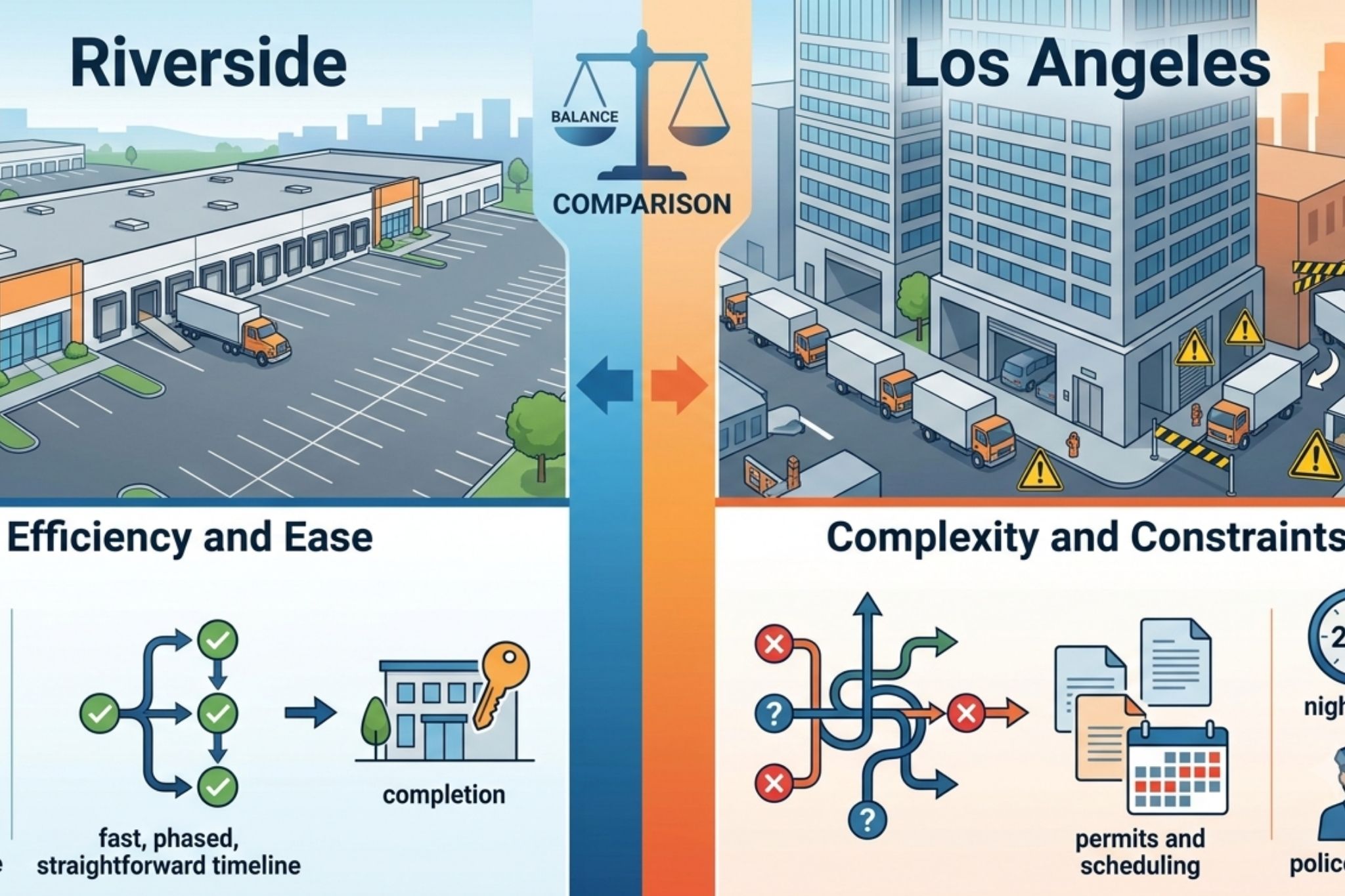
Riverside and Los Angeles are only about 60 miles apart, but a commercial move in one looks very different from a move in the other. LA’s high-rise density, tight street permitting, and heavy traffic create one set of challenges, while Riverside’s sprawling business parks, industrial warehouses, and government-adjacent office corridors create a completely different set. At Rapid Office Movers, we handle commercial relocations across both markets — here’s what actually changes when you move your business in Riverside versus Los Angeles.
Building Types: High-Rise Towers vs. Business Parks
The biggest structural difference between the two markets is the kind of building your business is likely occupying.
Los Angeles — especially Downtown LA, Century City, and Hollywood — is dominated by Class A high-rise towers, many managed by large commercial landlords. These buildings typically require freight elevator reservations, Certificate of Insurance (COI) approval, and loading dock scheduling before a single box can move.
Riverside, as the county seat and a major Inland Empire employment hub, has a lower-density commercial core. You’ll find legal offices near the county courthouse, professional practices along Magnolia and Arlington, a growing creative and professional corridor Downtown, and university-adjacent businesses near UCR — alongside a large share of industrial and warehouse space in the western and southern parts of the city. Riverside moves are far more likely to involve dock-height industrial loading than a freight elevator reservation.
Permits: Dense Curb Competition vs. Oversized Load Rules
Both cities require permits for certain commercial moves, but the type of permit — and why you need it — differs significantly.
In Los Angeles, the challenge is curb space. If your movers need to park or stage a truck on a public street, LADOT requires a Temporary No-Parking Permit, and in dense areas like Downtown LA, competition for that curb space is intense even with an approved permit posted.
In Riverside and the broader Inland Empire, permitting is more likely to involve oversized loads tied to the region’s massive logistics and warehouse sector. Caltrans requires a transportation permit for any load exceeding 8’6″ in width, 14′ in height, or 80,000 lbs., and the City of Riverside layers on its own oversized load permit requirements. If you’re relocating a business with industrial equipment, high-pile storage racking, or heavy machinery, factor in Riverside’s seismic engineering and high-pile permit requirements, which are notably stricter than what a standard LA office move would ever encounter.
Traffic and Scheduling: Freeway Corridors vs. Downtown Congestion
Los Angeles traffic is defined by dense, all-day congestion on major corridors like the 110, the 10, and surface streets such as Wilshire and Olympic. In LA, timing your move around rush hour — typically starting early morning — is critical no matter which neighborhood you’re in.
Riverside’s traffic patterns are shaped more by regional freeway movement than downtown gridlock. As a hub connecting LA, Orange, and San Bernardino counties, Riverside sees heavy freight and commuter traffic along its connecting freeways, but Downtown Riverside itself is far less congested than Downtown LA. That said, Downtown Riverside does have its own daytime parking constraints, and government-adjacent offices near the courthouse often require specific security scheduling — which is why many local commercial moves are scheduled during evenings or weekends to minimize disruption.
Cost Differences: Density Drives Price
Generally speaking, commercial moving costs in Los Angeles run higher than in Riverside, largely due to:
- Higher demand and traffic-adjusted labor time in LA
- Building-related costs unique to LA high-rises, such as COI requirements, elevator reservation fees, and loading dock charges
- Higher cost of living reflected in labor rates across the LA metro
Riverside, by contrast, generally offers lower hourly labor rates and fewer building-imposed fees, though large industrial or warehouse relocations can offset those savings with specialized equipment, racking installation, or oversized load permitting costs.
Industry Mix: Corporate Offices vs. Logistics and Industrial
This is where the two markets diverge the most. LA’s commercial base skews toward corporate offices, entertainment, media, and professional services concentrated in high-rise towers. Riverside — sitting at the heart of the Inland Empire, one of the largest logistics and distribution hubs in the country — has a commercial base far more weighted toward warehousing, distribution centers, and light industrial operations, alongside its legal, medical, and university-adjacent professional core.
That means a “commercial move” in Riverside is much more likely to involve pallet racking, dock-height loading, and equipment suited for high-pile storage facilities — logistics that a typical LA office mover may never encounter.
What This Means for Choosing a Mover
A moving company that’s excellent at navigating LA high-rises — freight elevator scheduling, COI paperwork, LADOT permits — isn’t automatically equipped for a Riverside industrial relocation involving oversized loads and dock-height logistics. And a mover experienced with Inland Empire warehouses may not have the building-relationship experience needed to get your business smoothly into a Downtown LA tower.
Rapid Office Movers operates across both markets and adjusts our approach based on the building type, permitting requirements, and industry needs specific to each city — whether that’s coordinating a freight elevator reservation in Downtown LA or managing an oversized load permit for a Riverside distribution center move.
Planning a commercial move in Riverside, Los Angeles, or between the two? Contact Rapid Office Movers today for a free quote built around your specific building, industry, and location.