Lab Equipment Relocation Checklist: What Movers Need to Know
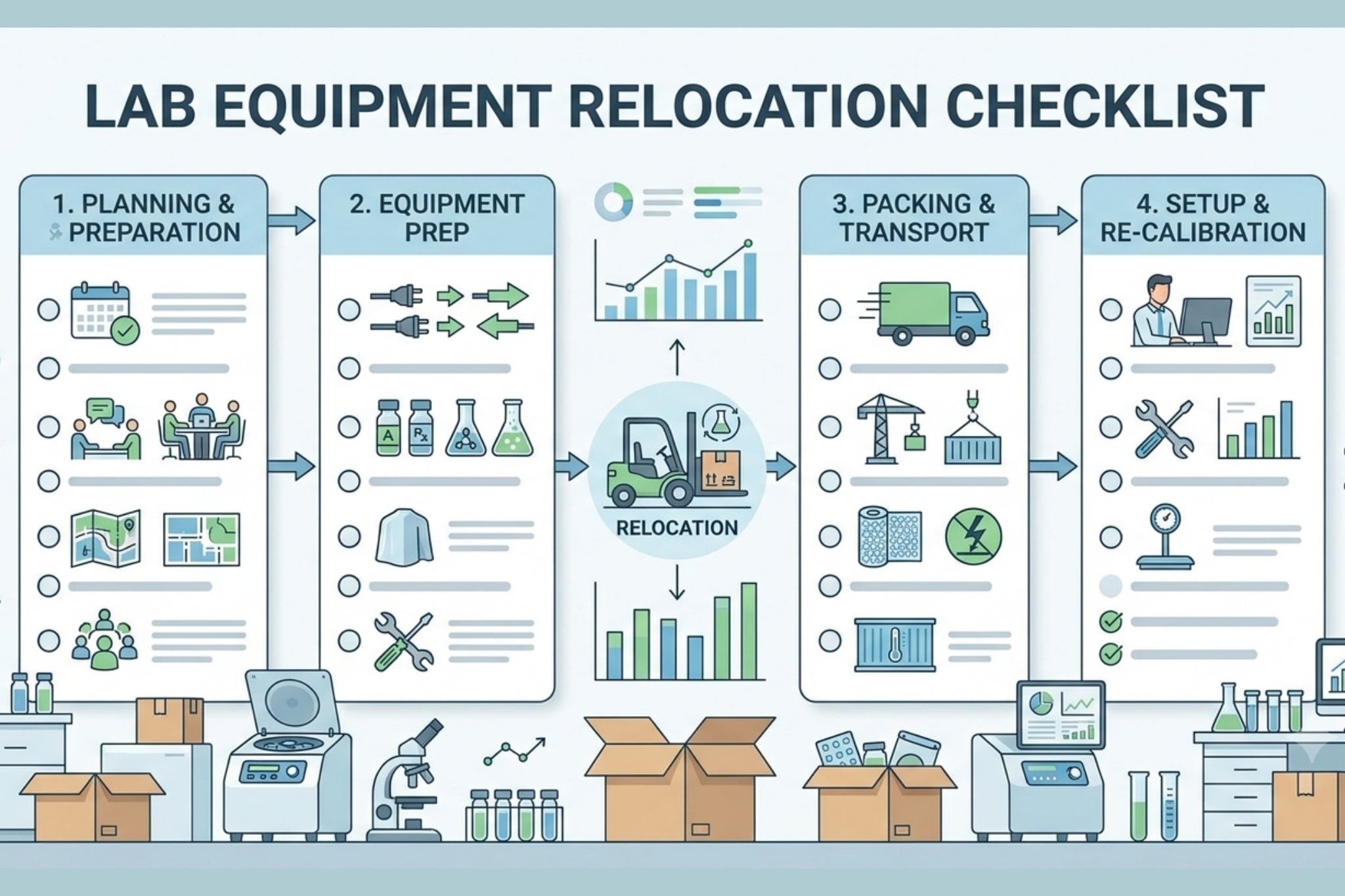
Lab Equipment Relocation Checklist: Relocating a laboratory is nothing like relocating an office. Analytical instruments can lose calibration from a single hard bump, biosafety cabinets and fume hoods require certified decontamination before they can leave the building, and hazardous materials are governed by strict federal transport regulations. At Rapid Office Movers, we work with research labs, biotech companies, and academic departments to plan lab relocations that protect equipment, keep staff safe, and stay compliant from start to finish. Here’s the complete checklist.
Lab Equipment Relocation Checklist
Lab moves take significantly longer to plan than they do to physically execute, and starting late is the single most common cause of delays.
- Begin planning 6–12 months before your target move date, especially for larger or highly regulated labs
- Notify your institution’s safety and compliance teams at least 6–8 weeks out — some institutional requirements call for 90 days’ notice
- Build your move team early, including safety officers, facility managers, IT, and (where hazardous materials are involved) a certified industrial hygienist
- As a general timeframe: small labs typically take a few days to a week to physically execute, mid-sized labs run two to four weeks, and large or highly specialized labs can take several months once decontamination and recalibration are factored in
Categorize Equipment by Hazard Class
Not all lab equipment can be treated the same way. Sorting instruments by hazard class early helps you plan the right handling, documentation, and vendor involvement for each:
- Non-hazardous analytical instruments — HPLC systems, UV-Vis spectrophotometers, balances, general benchtop equipment. No special permits required
- Biological/chemical residue risk — Biosafety cabinets, fume hoods, and equipment used with BSL-2 agents. Requires certified decontamination before transport
- Radiological equipment — X-ray generators, radioactive source-containing instruments, gamma counters. Requires radiation safety review and compliance with DOT hazmat shipping rules
- High-consequence regulated equipment — Select-agent-adjacent equipment, active superconducting NMR magnets, cryogenic storage containing viable biological material. Requires multi-agency coordination and is typically handled directly by institutional safety staff rather than a commercial mover
Decontamination: Non-Negotiable Before Anything Moves
Equipment that has been in contact with hazardous chemicals or biological material cannot simply be unplugged and wheeled out the door.
- Biosafety cabinets and fume hoods must be professionally decontaminated and certified before disconnection — some cases (like perchloric acid or radioisotope use) require special decontamination procedures
- Benchtops and work surfaces where biological or chemical materials were handled should be wiped down with an approved disinfectant or cleaning solution
- Major equipment — refrigerators, freezers, centrifuges, incubators, ovens, glove boxes — must be checked and decontaminated if there’s any chance of contamination
- Documentation matters as much as the cleaning itself. Most institutions require a signed decontamination form for each piece of equipment before it’s cleared for the move
- Radiological equipment requires a radiation safety officer to confirm the equipment and space are free of removable contamination, typically through a formal wipe survey
Handling Chemicals and Compressed Gas
- Chemicals must be identified, separated, packed, and labeled according to DOT hazardous materials regulations
- Never abandon hazardous chemicals in a vacated lab — they must be either relocated in compliant storage or submitted as chemical waste
- Compressed gas cylinders should not be moved with the rest of your equipment. Regulators must be removed and safety caps installed, and cylinders typically need to be returned to the supplier or handled through a separate arranged pickup
- Use only trained personnel and DOT-approved containers for hazardous material transport, with full chain-of-custody documentation
Protecting Biological Materials
- Biological samples, reagents, and cell lines require documented handoff between lab personnel, the moving crew, and the receiving lab
- Use primary leak-proof containers inside secondary puncture-resistant packaging, and monitor temperature-sensitive materials (dry ice or liquid nitrogen dewars) around the clock during transit
- BSL-1 and BSL-2 materials require specific containment during transport; anything BSL-3 or higher is generally handled directly by institutional staff rather than a commercial moving crew
Protecting Calibration and Instrument Integrity
- Most precision lab instruments lose calibration when moved, even with careful handling
- Coordinate power-down and recommissioning with the original equipment manufacturer or a certified calibration vendor — and build your move schedule around their availability, not the moving crew’s
- Keep manufacturer instructions and prior calibration records with each instrument so recommissioning at the new site goes faster
- For cleanroom environments, equipment should be properly wrapped and decontaminated before leaving one cleanroom classification and re-decontaminated before entering another
Choosing a Mover That’s Actually Equipped for Lab Work
Not every moving company is set up to handle a laboratory relocation safely or in compliance with regulations. Look for:
- A documented history of lab, biotech, or research relocations, not just general office moves
- OSHA-aligned and biosafety-aware crew members with documented training
- A pre-move site survey and a signed-off load plan — not just a phone quote based on a rough inventory
- Fast turnaround on Certificate of Insurance (COI) documentation matched to your building’s specific requirements
- A clear understanding that fume hoods and similarly integrated equipment require disconnection from ductwork, gas, water, and electrical by qualified tradespeople, not general labor
After the Move: Don’t Skip the Post-Move Safety Check
- Conduct a final safety and compliance check at both the origin and destination lab
- Maintain an accurate inventory record of everything moved for audit and compliance purposes
- Decontaminate personnel, equipment, and transport vehicles as required, and dispose of any contaminated materials according to protocol
- Report any spills, leaks, or incidents that occurred during the move to the appropriate safety authority
- Confirm instrument recalibration is complete and documented before the lab resumes normal operations
How Rapid Office Movers Supports Lab Relocations
A lab move succeeds or fails in the planning phase — long before moving day. Rapid Office Movers works alongside your safety officers, calibration vendors, and facilities team to build a relocation plan that respects hazard classifications, decontamination requirements, and the realities of moving sensitive scientific equipment.
Planning a lab relocation? Contact Rapid Office Movers today to start building a compliant, well-sequenced move plan around your lab’s specific equipment and regulatory requirements.