
How Much Does It ACTUALLY Cost to Move an Office in LA? (The Numbers Will Surprise You)
How Much Does It ACTUALLY Cost to Move an Office in LA? Ask five moving companies what an office relocation costs and you’ll get five different vague answers, usually some version of “it depends.” Which is true, but not very useful when you’re trying to build a budget. So let’s actually talk numbers — what a Los Angeles office move typically costs by size, what pushes that number up, and the cost most businesses completely forget to include until it’s already too late.
How Much Does It ACTUALLY Cost to Move an Office in LA?
For a local move in LA, most businesses land somewhere in these ranges:
Small office (up to ~10 employees): roughly $1,000–$5,000 Mid-size office (25–100 employees): roughly $5,000–$15,000 Larger office (100–200+ employees): $15,000–$30,000, sometimes more depending on complexity
Movers commonly price by square footage too, often landing somewhere around $5–$8 per square foot for the physical move itself. A 10,000-square-foot office, for example, can easily land in the $50,000+ range once everything is included — not just trucks and labor, but IT, furniture, and setup.
Those ranges are wide on purpose, because the real answer depends on a handful of specific factors — and one number that almost nobody accounts for.
What Actually Moves the Price Up
Square footage and volume, more than headcount. Two offices with the same number of employees can cost very differently to move depending on how much furniture, equipment, and storage they’ve accumulated. A lean startup with 30 people and minimal furniture will almost always move cheaper than a 30-person office that’s been in the same space for a decade.
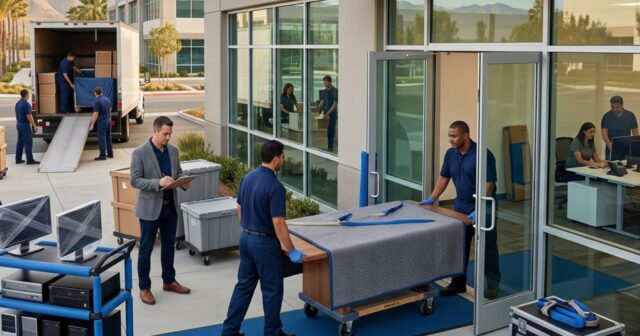
Building access in LA specifically. This is where Los Angeles adds its own premium. Downtown high-rises with elevator reservation windows, buildings requiring a Certificate of Insurance, limited loading dock access, and street parking restrictions all add time — and time is the thing you’re actually paying for in a local move, which is typically billed hourly per crew member.
IT and technology setup. This is the piece that catches people off guard. Most base moving quotes cover physical transport of computers and servers, not the cabling, network configuration, or system testing needed to get everything running at the new space. For a mid-size office, IT relocation alone can add several thousand dollars on top of the physical move.
Furniture — new or existing. If furniture is being replaced rather than moved, that’s an entirely separate budget line, and it adds up fast per employee once desks, chairs, and workstations are all factored in.
After-hours or weekend scheduling. Moving outside business hours to avoid disrupting operations typically adds a premium — often somewhere in the 20–30% range compared to a standard weekday move.
The Cost Almost Nobody Budgets For
Here’s the number that actually surprises people: downtime.
Industry estimates put the value of a single office worker’s day at roughly $100–$200 in lost productivity if they can’t work. Multiply that across a team, across a multi-day move, and it adds up fast. A three-day move for a 50-person team, for example, can represent $15,000–$30,000 in lost productivity — often more than the physical moving invoice itself.
This is exactly why after-hours and weekend moves, despite costing more upfront, are frequently the cheaper option overall. Paying a 20–30% premium to avoid two lost business days is usually a better financial decision than saving on the mover’s invoice and eating the cost in stalled operations instead.
A Rough Way to Estimate Your Own Downtime Cost
You don’t need a complicated formula. A simple version looks like this:
(Estimated daily value per employee) × (number of employees affected) × (days of disruption) = downtime cost
Even a rough version of this number is useful, because it gives you something concrete to weigh against paying extra for a faster, off-hours move.
Why LA Specifically Tends to Run Higher
Los Angeles adds a few cost factors that a move in a smaller market wouldn’t necessarily involve: higher local labor rates, more buildings with strict access and insurance requirements, heavier traffic affecting scheduling and staging, and, depending on the neighborhood, tighter parking and loading logistics. None of this means an LA move is automatically expensive — it means the building type and location matter more here than in a lot of other cities, and it’s worth discussing specifically with whoever is quoting your move.
How to Get a Number You Can Actually Trust
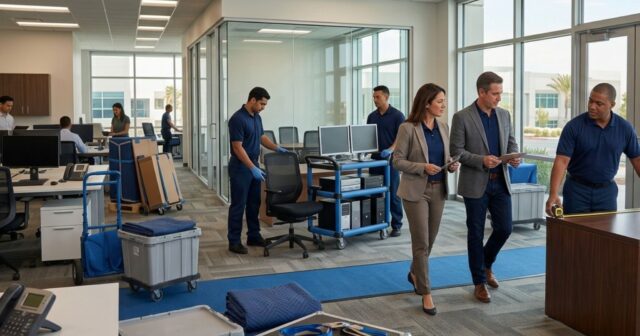
The biggest gap between an estimate and a final bill usually comes from scope, not dishonesty. A quote based on a real walkthrough of your space, one that clearly states what’s included (packing, IT handling, furniture assembly) and what isn’t, is far more reliable than a rough number given over the phone. If a quote seems unusually low compared to the ranges above, it’s worth asking directly what’s excluded before assuming you found a bargain.
Frequently Asked Questions
How much does it cost to move a small office in Los Angeles? Small offices with around 10 employees typically fall between $1,000 and $5,000 for a local move, depending on distance, building access, and how much furniture and equipment is involved.
Is downtime really more expensive than the move itself? For larger offices, often yes. Lost productivity during a multi-day move can exceed the cost of the physical relocation, which is why many businesses opt for after-hours or weekend moves despite the added labor premium.
Why do office moves in LA cost more than in some other cities? Higher local labor rates, stricter building access requirements (like elevator reservations and insurance documentation), and traffic-related scheduling challenges all tend to push Los Angeles moving costs higher than smaller markets.
Does a moving quote usually include IT setup? Not always. Many quotes cover physical transport of computers and servers but not cabling, network configuration, or system testing. It’s important to confirm this directly before comparing quotes.
How can I get an accurate quote instead of a rough guess? Request a walkthrough-based quote that clearly itemizes what’s included. A detailed, written estimate based on your actual space and inventory is far more reliable than a phone estimate.
Want an Accurate Number for Your Office?
Rather than guess where your move falls in these ranges, we’re happy to walk through your space and put together a clear, itemized quote — including the parts of the cost most estimates leave out. Reach out to Rapid Office Movers for a free consultation.